Blaydon Hattersley
Poor ThingsBlaydon Hattersley is an industrialist who rises from poverty to considerable wealth and influence, and the father of Victoria Hattersley, the woman whose body becomes Bella Baxter’s. His reunion with Bella brings family identities, class ambition, and concealed histories into the open. He describes himself as a self-made businessman who forced his way upward, but his own account also shows the cost of that success: he treats relatives as obstacles, his daughter as a social prospect, and her pregnancy as something from which he must escape.
Identity and Industrial Rise
Blaydon is introduced as a swarthy, thickly built, wild-looking old man, struggling to his feet beside General Sir Aubrey de la Pole Blessington. The General identifies him as Victoria Hattersley’s father and as the managing director of the Union Jack Steam Traction Company of Manchester and Birmingham. At this first encounter, Bella studies both men with interest but cannot remember either. The scene’s central contradiction is that she is looking at her father and her first husband without the memories that would make them familiar: the woman called Bella is connected to Victoria Hattersley through a history she does not recall.
Blaydon’s account of his beginnings is shaped by fear of poverty. He says that he dragged himself, his wife, and Victoria out of the deprivation of Manchester by pushing weaker competitors beneath him. His three young sons died of cholera, a loss he sets beside the dangers he believes he has had to master: hunger, poverty, and the contempt of the wealthy. He describes taking his uncle’s share in a workshop, then defeating the uncle’s attempt to retaliate by joining George Hudson, the Railway King. Blaydon boasts that he defeated both men. Ten years later, he says, he had an earl on his board, could place men in Parliament, and employed half the skilled workforce of Manchester and Birmingham.
The later annotation on the story’s industrial history gives a concrete measure of that ascent. The patent for the MacGregor Shand twin reciprocating gubernator sockets gave the Steam Traction Company an advantage over competitors until the Belfrage popper valve made gubernators obsolete in 1889. The note concludes that Blaydon’s daughter’s father became a millionaire when she was three. His success is therefore not merely asserted through his own swagger: the patent and its commercial advantage locate the family fortune within a specific industrial change.
Family, Class, and Marriage
Blaydon’s wealth does not make him a tender parent. He admits that business kept him too busy to pay much attention to Victoria until she turned seventeen and he recognized her beauty. He then sent her to a Swiss convent, instructing its superior to make her fit for the highest marriage prospects, whatever the cost or time required. The process took seven years. His wife died before Victoria returned, and Blaydon says he was glad, believing her plain manners would have damaged their daughter’s prospects among the wealthy.
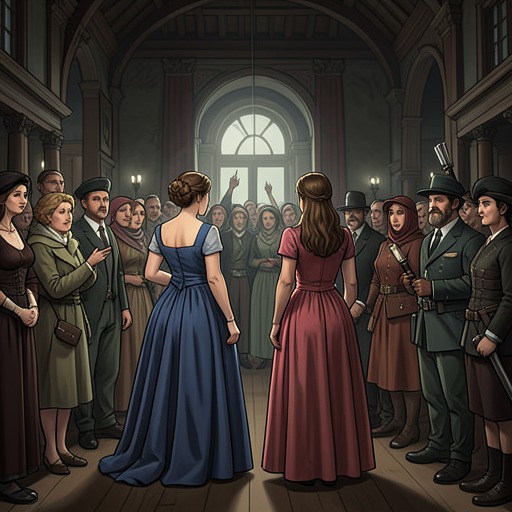
The General recalls Victoria as beautiful and innocent, while Blaydon frames the marriage in terms of status and restricted choice. He says she was expected to love the General, a national hero and cousin of the Earl of Harewood, and points out that at twenty-four she had been allowed to meet no man other than her father and her future husband. He arranged an elaborate wedding reception and banquet at Manchester Free Trade Hall, with the Cathedral choir singing the Hallelujah chorus. The celebration marks the success of his social plan, but the facts he supplies expose its limits: Victoria’s apparent adoration developed within a life carefully managed by her father and a very narrow field of permitted choices.
The Reunion and His Confession
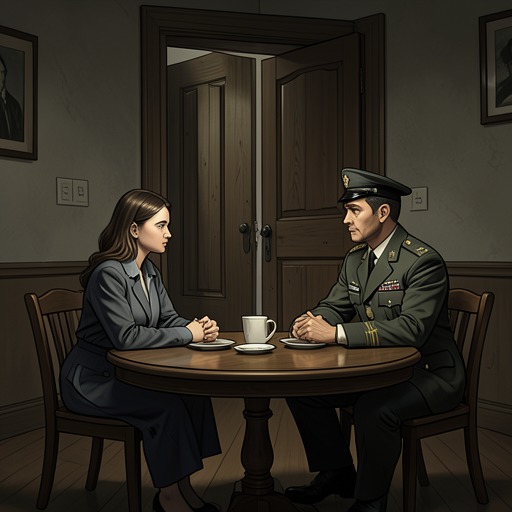
When Bella asks whether she loved the General, Blaydon answers for her, insisting that she adored and worshipped him. Yet the reunion soon shifts from the story of the marriage to Blaydon’s treatment of his daughter when she returned to him. Bella asks what he did to her. He acknowledges that he did the wrong thing: rather than keeping her with him and negotiating a better settlement with the General, he told her that a wife who left her husband must fight the marital war at home. He presented this advice as moral instruction, but admits that he wanted her out of his house and out of his sight.
The reason he gives is bluntly physical and self-interested. He hated the blood, screams, and mess of childbirth and feared that Victoria would go into labour near him. He hurried her to the station, bought her a first-class ticket to London, and left when she said she could manage alone. In his account, she then exchanged it for a third-class ticket to Glasgow. The detail turns his remorse into a precise confession: he did not simply fail to protect her; he arranged her departure and abandoned her at the moment she needed support. Bella’s calm declaration that she will stay makes the contrast unmistakable. His account gives her history, but it does not give him authority over her present.
Blaydon as Father to Bella
Bella responds to Blaydon’s confession by thanking him for giving her life while observing that, by his own description, her mother bore most of the trouble. She also refuses the premise that biological parenthood entitles him to decide her future. Life without freedom to choose, she says, is not worth having. Her thanks to him is therefore not reconciliation on his terms: she can acknowledge his place in her history while rejecting his control.
In another account, a conversation about the patent makes Blaydon’s family power appear in a different light. He says he gained the patent and much more from Bella’s brother Noah, then warns her not to receive visitors until she can behave in a ladylike fashion, suggesting that Mabel teach her how to sit, dress, stand, walk, and speak. When Bella later tells him that Mother drinks every day, he treats her self-destruction as acceptable so long as it remains quiet and private. Bella’s request is not for money or status but for books and the chance to learn. These exchanges reinforce a pattern visible in his account of Victoria: Blaydon determines what others ought to become, while their own needs receive little attention unless they can be accommodated to his convenience.
Narrative Role and Significance
Blaydon’s forceful account of his success complicates the conventional image of the benevolent, prosperous father. He has escaped poverty, but remembers that escape as a struggle in which the weak could be pushed down; his business achievements and his family decisions share that uncompromising logic. He pays for Victoria’s education in order to prepare her for an advantageous marriage, then abandons her when pregnancy threatens to bring discomfort into his home. His admission that he was afraid and that he acted selfishly makes him more revealing than a simple antagonist: he understands, after the fact, that he failed her, yet his apology cannot undo the decision.
Victoria’s later interpretation of Archibald McCandless’s narrative gives Blaydon another function. She argues that Archibald envied her wealthy father, convent education, and famous first husband, as well as the care and companionship Godwin Baxter gave her. In her reading, Archibald’s fiction rearranges those inequalities by imagining a shared deprivation for himself, Godwin, and Victoria. Blaydon consequently stands not only as a character in the family history but also as part of the disputed social world that the competing accounts attempt to explain. His wealth, his daughter’s marriage, and his confession all matter; but the story’s layered telling leaves readers to distinguish the remembered person from the uses later narrators make of him.